Mary thinks she’d be happy if she could just change her weight, her looks and her job. Sean believes that he’s an okay person except for certain personality traits, such as anxiety, impatience and his quick temper. Yolanda’s shelves are overflowing with self-improvement books; she’s read them all but she still hates herself.
Who among us doesn’t believe that with a little tweaking, we could be just right—self-realized, self-actualized and self-helped to just short of perfection? But, the problem for many is that all the books, self-improvement tips and positive affirmations don’t seem to make us any happier. Worst of all, the minute we “fix” one ugly piece of ourselves, another nasty monster rears its head and starts screaming for attention.
When does self-help become self-hell? What would happen if we simply started by realizing how wonderful we already are?
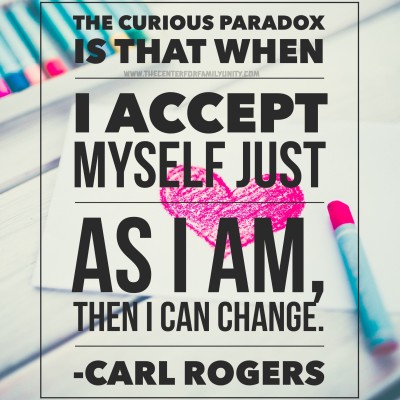
As the pioneering psychologist Carl Rogers once wrote, “The curious paradox is that when I accept myself just as I am, then I can change.”
“Believing that something is wrong with us is a deep and tenacious suffering,” writes Tara Brach, in her book, Radical Acceptance, “The more we anxiously tell ourselves stories about how we might fail or what is wrong with us or with others, the more we deepen the grooves—the neural pathways—that generate feelings of deficiency.” She lists common ways people try to manage this pain of inadequacy:
• Anxiously embarking on one self-improvement project after another.
• Holding back and playing it safe rather than risking failure.
• Withdrawing from our experience of the present moment.
• Keeping busy.
• Becoming our own worst critics.
• Focusing on other people’s faults.
“Convinced that we are not good enough, we can never relax,” Brach writes, “We stay on guard, monitoring ourselves for shortcomings. When we inevitably find them, we feel even more insecure and undeserving. We have to try even harder.”
Accepting ourselves does not mean self-indulgence or being passive. Rather it means turning off the shameful, negative, self-loathing tapes within ourselves and just relaxing.
The blaring voices of our culture certainly don’t help, with promises that buying something, owning something, achieving something will make us better people, that success is measured by looks, wealth or possessions. A healthier life finds deeper meaning and greater satisfaction in self-love, compassion, intuition, taking responsibility, and forgiveness (particularly of ourselves).
Sometimes it is our so-called faults that can actually lead us to a healthier life. Pioneering psychologist Carl Jung called it our “shadow side,” that part in all of us we are ashamed of and that we often reject. Understanding and accepting that shadow side can lead to enormous freedom and self-acceptance.
Science and research has revealed much about what we can and cannot change about ourselves, according to Martin Seligman, Ph.D., author and Director of Clinical Training in Psychology at the University of Pennsylvania. “Some of what does change is under your control, and some is not,” he writes in his book, What You Can Change and What You Can’t.
Seligman lists some characteristics that are easier to change, such as everyday anxiety, specific phobias, panic, anger and certain beliefs about life. He advises people to discard the notion of changing that which hurts the most (for example, your extra weight) and instead concentrating on those parts of yourself that will respond most successfully to your efforts to change them (for example, your shyness or impatience with your spouse).
In the end, all the energy we put out to change ourselves may just take us back to where we started—to ourselves. And if we can truly accept ourselves as we are, that’s the best place to be.
We all need support and encouragement. Contact us at The Center for Family Unity and schedule your FREE 30 minute consultation to find out how you can give yourself the best Valentine gift of all!